


Drawing From Art: Backgrounds

When I was in my early 30s, good fortune came my way in the form of a brilliant painter, who was kind enough to mentor me: Murray Miller. He took me under his wing and gave me the education I had been seeking since I was a child.
Early on during my childhood, I was about 4 or 5-years-old, two major influences put me on my journey towards art. I saw Walt Disney’s Fantasia and the Disney illustrated Golden Book, Grandpa Bunny. Both the film and the little book brought dreams to life in that they created a fantastical and wondrous world filled with magic and beauty. Fairies, flowers, images that delighted and thrilled a small child (as well as many adults!) abounded. At the same time as I was introduced to these masterpieces of dreams-come-true, I had a profound experience. My Parents had purchased a very old row house in Brooklyn that was fitted with crystal and porcelain knobs, pocket doors and gas wall-jets, converted to electric wall sconces. In the basement was an elaborate filigreed, brass grate. Through this magic portal I could see our backyard. However, in my youth I perceived the scene through the grate as an enchanted garden. This garden changed with the seasons and in my mind, it was the same fantasy as Fantasia and Grandpa Bunny. I, too, wanted to sprinkle the world with fairy dust to make it a magical place.
I grew up painting, photographing and drawing. With my first pay-check as a camp counselor bought a large boxed set of pastels. I was serious about art. Studying the illustrations of great artists, such as Christie, Maxfield Parrish and the Leyendecker brothers provided the realism I loved. They also focused their art on beauty, glamour. The great N. C. Wyeth, painted thrilling adventure stories in brilliantly dynamic colors. However, I was not schooled in many of the necessary or traditional techniques of realism. Perhaps there are artists who say, “Art is created by the artist.” Yes, that is true, but I like the underpinnings of fact before I delve into fancy. More specifically, if you look at imaginative and innovative Klimt’s earliest work, you can see a knowledge of form, composition, line. Then, Klimt left traditional realism, of course taking a few notes with him, to create the Vienna Secession Movement. I was schooled in university and graduate school in abstract art. Pollack, Rauschenberg and many others were the “standard.” I was intrigued and still have some of my abstracts, but I wanted to learn about realism.
Not knowing the fundamentals of painting and drawing realistically (anatomy, form, et.al.) I was struggling to move away from my university abstracts to a more traditional type of painting. Mr. Miller taught me about realism by showing me and discussing pictures from books (computers were a dream away), slides he had taken in museums and by attending one-pose 3-hour nude poses each week for several years. He little-by-little poured his knowledge of traditional realism into my hunger for it. I wanted to begin from a point of traditional art to go on to create my own style. Miller’s tutelage gave me the beginning. Each week, I learned form, line, composition, anatomy, relationships. I was absorbing lessons in art from a mentor who had studied them his entire life.
To the point: One day, I went to Mr. Miller’s studio where he was painting a large portrait of a family. “Arggggg,” he said. “I want to finish this by the deadline!” “I’ll paint in the background,” I said, thinking I could help. After all the background is just some paint behind the subject(s). “You don’t understand backgrounds. They are extremely difficult to integrate into the work,” my mentor told me. I then learned that in most art, the background is as important as the subject itself. I was amazed by this revelation. I never really thought of the background as a key element of a composition.
I began to study backgrounds: positive/negative space; scenery; variegated color, shadows and other types of backgrounds that would make the subject “Pop.” Subjects also had to be entwined with backgrounds to create a logical as well as pleasing painting/photograph. Placing a subject into a composition with no consideration for its surroundings is jarring for the eye. I began to notice how the masters brought subjects to life by creating backgrounds that emphasize the subjects.

The Titian’s Goblet by Thomas Cole is a wonderful example of a subject, the brimming goblet, showcased by a beautifully subtle landscape. Cole enhances the goblet with a muted landscape that heightens the vessel’s symbolic overflowing civilization. Alone, the vessel could be interpreted as the passage of time and the evolution of humanity, or simply a stone relic. However, the background gives a deeper meaning to the subject by providing the viewer with a monumental landscape: mountains, valleys, rivers, meadows. All muted to give the goblet, as the subject, the composition’s main focus.
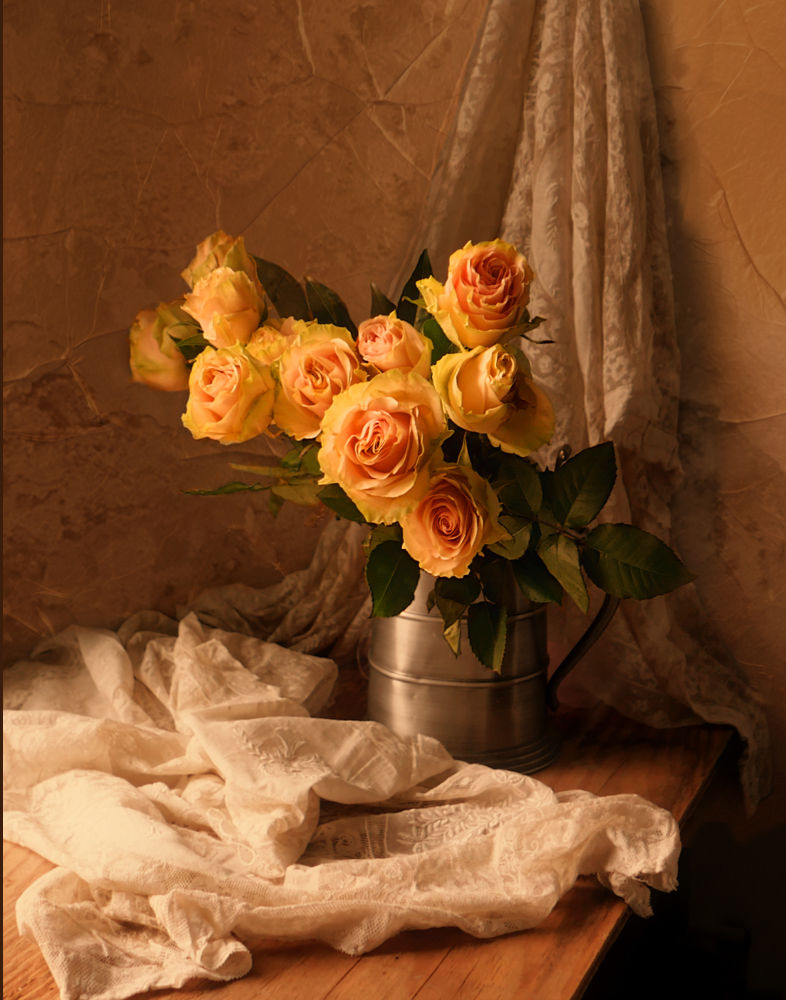
When I saw these roses in a shop, I was captivated by their shapes, color, absorption of light, and affinity for creating their own composition by falling towards each other and most seeking the light.
After arranging the flowers in a tin tankard, this to give contrast to the breathtaking beauty of the roses, I set the container on a plain wooded plank in my North facing studio window.
The composition seemed incomplete. Background was lacking. I draped a lace cloth on the plank and pinned some lace on the wall behind the roses. Suddenly the composition came together and had meaning for me. The contrasts provided interest and the background emphasizes the natural beauty of the roses. The subtle approach of adding a background that enhances the subject, employed by Thomas Cole greatly benefited my own composition.

This Still Life by Willem Claesz Heda painted in 1634, may appear more like the still life expected by viewers: objects grouped together, fruit and/or other edibles, sometimes flowers (but not here). But, notice the background. It is not flat, static paint, but filled with varying light and shadows, moving the eye from one area of the composition to another. The cloth on the table, too, moves from light to dark, flat to creased, providing the eye with interest. The background is very much as filled with appeal as the objects on the table.

My still life of various forms and lines; light and dark; spiky and smooth textures is of many subjects, each integrating with and complementing the others. The rich colors of the flowers and the wine are juxtaposed with the subtle crumb of bread and pale pink napkin.
To add more form and complex contrast to the background seemed excessive and detractive. Therefore, I used the light and shadow approach employed by Willem Claesz Heda for an interesting yet subtle background that emphasizes the still life.
Lesson learned: Backgrounds emphasize and complement the subject of an artwork. Just as my personal background when growing up directed the course of my art journey, backgrounds of visual arts are essential to the overall compositions with which they integrate.


Comments