


Drawing From Art: Photography

January 16, 2026
As seen below, the images of Wassily Kandinsky’s black and white line composition and my sepia photograph may, at first glance, seem completely disparate, but let me explain what I learned from the great Kandinsky:
Line is a critical component of any visual art. Line in dance; line staging in theater; line in painting or photography, line is critical among many other visuals, too. Kandinsky was a genius with line. The lines in Kandinsky’s art create movement or stillness; design and composition; form and plane. His passion for abstraction is evidenced in the great artist’s use of lines Kandinsky is quoted as having said, “A line can say everything.”
Kandinsky studied traditional art of the mid-late 1800s. There are two interesting stories about his sudden fascination with abstraction (a movement that gained momentum in the mid to late 19th Century). One tale tells of Kandinsky’s chancing upon his own representational painting turned upside down, thus abstracting the subject of his painting (an owl). Another recalls Kandinsky’s seeing one of Monet’s Haystacks paintings for the first time. At first Kandinsky could not tell what the subject of the work was, but he was greatly impacted by its color.
“That it was a haystack the catalogue informed me. I could not recognize it. This non-recognition was painful to me. I considered that the painter had no right to paint indistinctly. I dully felt that the object of the painting was missing. And I noticed with surprise and confusion that the picture not only gripped me, but impressed itself ineradicably on my memory. Painting took on a fairy-tale power and splendour. ” — Wassily Kandinsky (Lindsay)
It was then, after seeing Monet’s Haystacks, that Kandinsky became fully devoted to abstraction, particularly colored shapes. Later he simplified his art into lines, some line art included color and there were also many artworks of black lines on white. In his 1926 book, Point and Line to Plane, Kandinsky discusses the meanings of various lines: their shapes, thickness, and a relationship Kandinsky created between certain lines and colors. Obsessed with line, in his book Point and Line to Plane (1926), Kandinsky explains the various types of lines, all of which he finds “spiritual” and deeply emotional. These are some of the lines that Kandinsky wrote about:
Circle: a line that begins where it ends is a line that never stops its dynamic
Triangle: an assertive line that points to a particular space
Horizontal: this line is stability and/or rooted in its place
Curved: a flowing, fluid line that softens its space
Semi-circle: a line that is expressing openness because it is not a closed circle. The semi-circle is a line of chance, waiting to be finished (Kandinsky).
Kandinsky, Wassily (1926). Point and Line to Plane. Bauhaus Books.
Lindsay, Kenneth C. (1982). Kandinsky: Complete Writings on Art. G.K. Hall & Co.
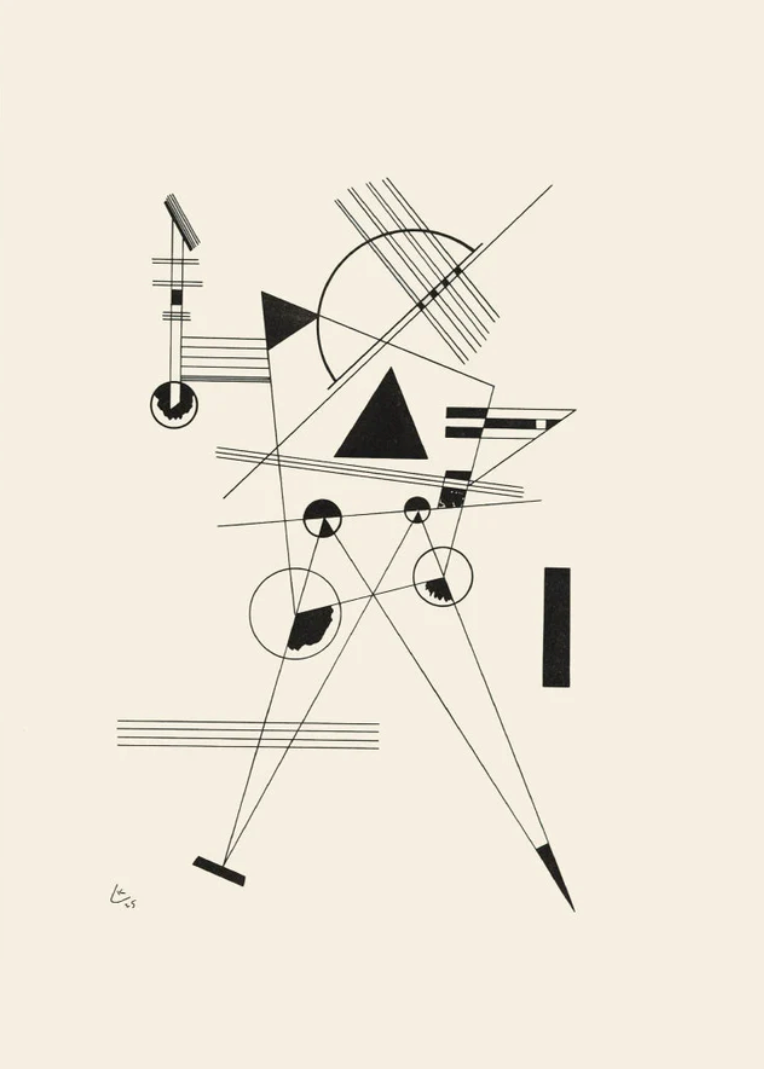
Notice the dynamic of Kandinsky’s “Composition.” The artist uses line to create a work of constant movement and flow. The triangles are forceful in directing the eye and the horizontals and small circles keep the viewer inside the lines, so to speak. The top, large semi-circle and bold diagonal strokes give expectancy to the work: Where is it going? What comes next?
This line drawing by the master Kandinsky is perfectly composed, yet the viewer searches for more: the composition is created with the passion and care that Kandinsky felt about line.

At first glance, my photograph may seem quite disparate from Kandinsky’s line “Composition.” However, many of the elements are the same.
The large semi-circles of the staircase (incomplete), the ceiling and the balcony suggest an opening or “come hither” into the light effect. The many vertical lines provide a structure to the architecture, while the large circle on the floor and its repeating outer circles are a never-ending dynamic with assertive triangles propelling the eye towards the center circle, which bounces the eye up to the repeating arch lines above.
Although my and Kandinsky’s art are completely different, the lines in each work create a path for the eye. The viewer draws conclusions from the lines and the works are completed by the interaction among the various lines and their interactions.
Lesson learned: Consider carefully the placement and shape of line. Lines may define the entire
work.


Comments